
Live, Work, and Play: What HCLA Taught Us About Planning and Infrastructure Ι Leslie Poynter, HCLA Class of 2027
A place where you can live, work, and play, and where your commute is under 30 minutes. The dream!
More than once during our November Hamilton County Leadership Academy (HCLA) Class of 2027 session on Planning and Infrastructure, we heard that “live, work, and play” is a central goal of community development. It’s what the planning process aspires to create. As we dug deeper, though, we explored how complicated it is to build communities where all three come together in one place, for everyone. Creating the high quality of place we’ve come to expect in Hamilton County is a long-term, multi-faceted endeavor. Personal and community preferences, political tides, legislative definitions (or the lack of them), and economic desires all intersect, and they can either slow a community’s growth or speed it up.
Growth in Westfield
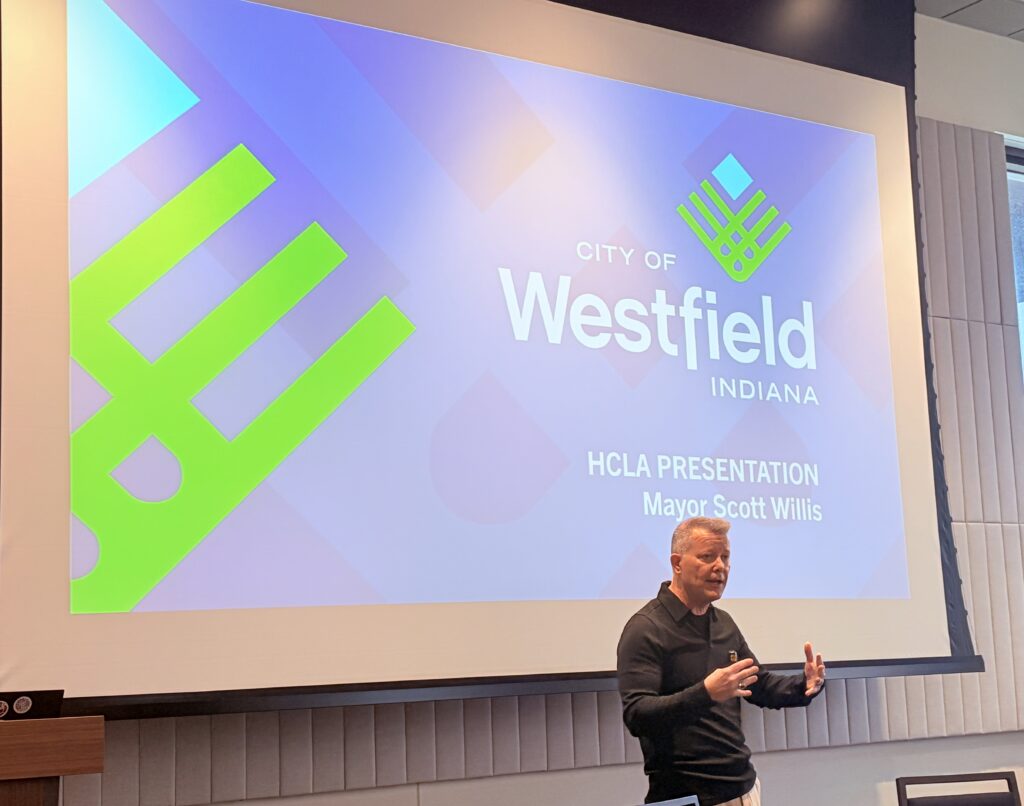 For many parts of Hamilton County, the answer lately has been full-throttle growth. Our conversation with Westfield Mayor Scott Willis offered plenty of examples. He noted that two years ago, Westfield was the second-fastest-growing city in Indiana and the sixth-fastest in the nation, the only Midwestern city on that list.
Mayor Willis reminded us that growth doesn’t have to be fully mapped out before a community can attract something new. Growth should pay for growth, and new amenities help pave the way for roads, parks, and other improvements. Process still matters, though. Developing a comprehensive plan and agreeing on its 27 place types helps get everyone on the same page, and definitions carry weight. What’s “old suburban” to you might be “new suburban” to your neighbor. Agreeing on those terms is a key first step toward agreeing on community plans.
Planning, creativity, and change
Corby Thompson (HCLA Class of 1994; HCLA Dean, 2017 and 2018) of Boomerang Development led us through the history of planning and development in Hamilton County. His message: change is the one constant.
We may no longer live in the era depicted on Indiana’s state seal, with trees being felled and buffalo roaming free, and projects can take longer today as ordinances have evolved. But Corby urged us to keep creativity alive despite lengthy regulatory processes and consolidated corporate control of development. He also noted that roughly 30% of the cost of a new home comes from regulatory processes, a sobering thought as costs continue to climb.
Becoming a planning changemaker
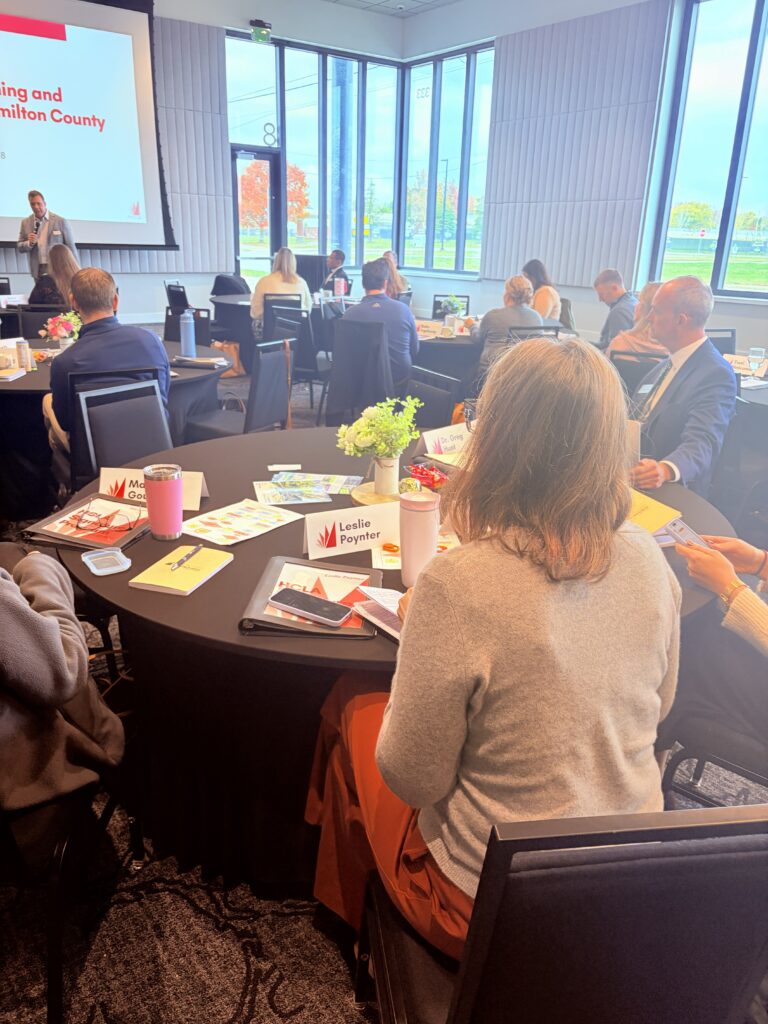 Want to shape what gets built? You could serve on a city board or commission that recommends which projects receive Tax Increment Financing (TIF) dollars, a tool that directs future property tax growth in a defined area back into improvements there. Henry Mestetsky (HCLA Class of 2019), Executive Director of the Carmel Redevelopment Commission, showed how Carmel has used this approach, with project after project that channeled growth, created vibrancy, and continues to fuel the city’s economic development.
Affordable housing
Returning to live, work, and play, Andrea Davis (HCLA Class of 2014), Executive Director of HAND, centered our conversation on affordable housing. Can everyone who grew up in Hamilton County afford to stay here as housing prices rise faster than incomes?
She also offered a perspective shift: homeowners who deduct their mortgage interest are, in effect, receiving a housing subsidy too.
The stakes are real. She highlighted that one in four Hamilton County households, or 35,456 in all, struggle to meet basic needs. Housing affordability is a topic we can’t ignore.
Annexation and reorganization
Our final speaker, Jennifer Miller (HCLA Class of 2011), Director of Planning and Development for the Town of Sheridan, walked us through annexations and reorganizations. She showed how change through the reorganization process significant creates opportunities while, in Sheridan’s instance, also necessitates a balance of growth, rural character, and historic preservation.
Back to play
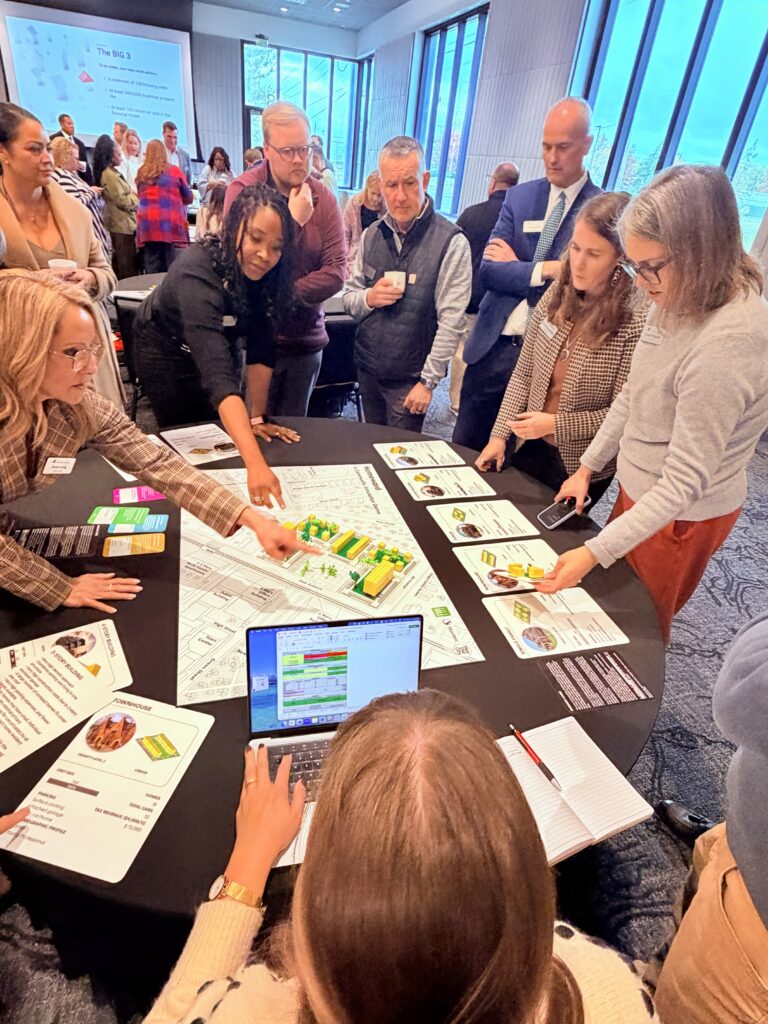 After a day of talking about living and working, our class fittingly returned to play. A simulation exercise from the Urban Land Institute was the perfect way to close, letting us apply what we’d learned as we searched for the mix of housing density that would meet the game’s goals. Healthy rivalry between our two teams proved a recipe for success.
Every HCLA session leaves me grateful for the curiosity we bring to each topic, for time together as a community, and for what we learn. To everyone who contributed to our learning this month, thank you! Here’s to more living, working, and playing together in the days ahead.